Shockwave therapy — the honest version
You’ve probably seen shockwave advertised with big promises. Here is exactly what it is, what the course of treatment involves, and what the research does and doesn’t show — so you can decide with a physician’s help.
George W. Carroll, MD Florida license ME48111NPI 1073644985 Men’s sexual medicine since 1992
What it is
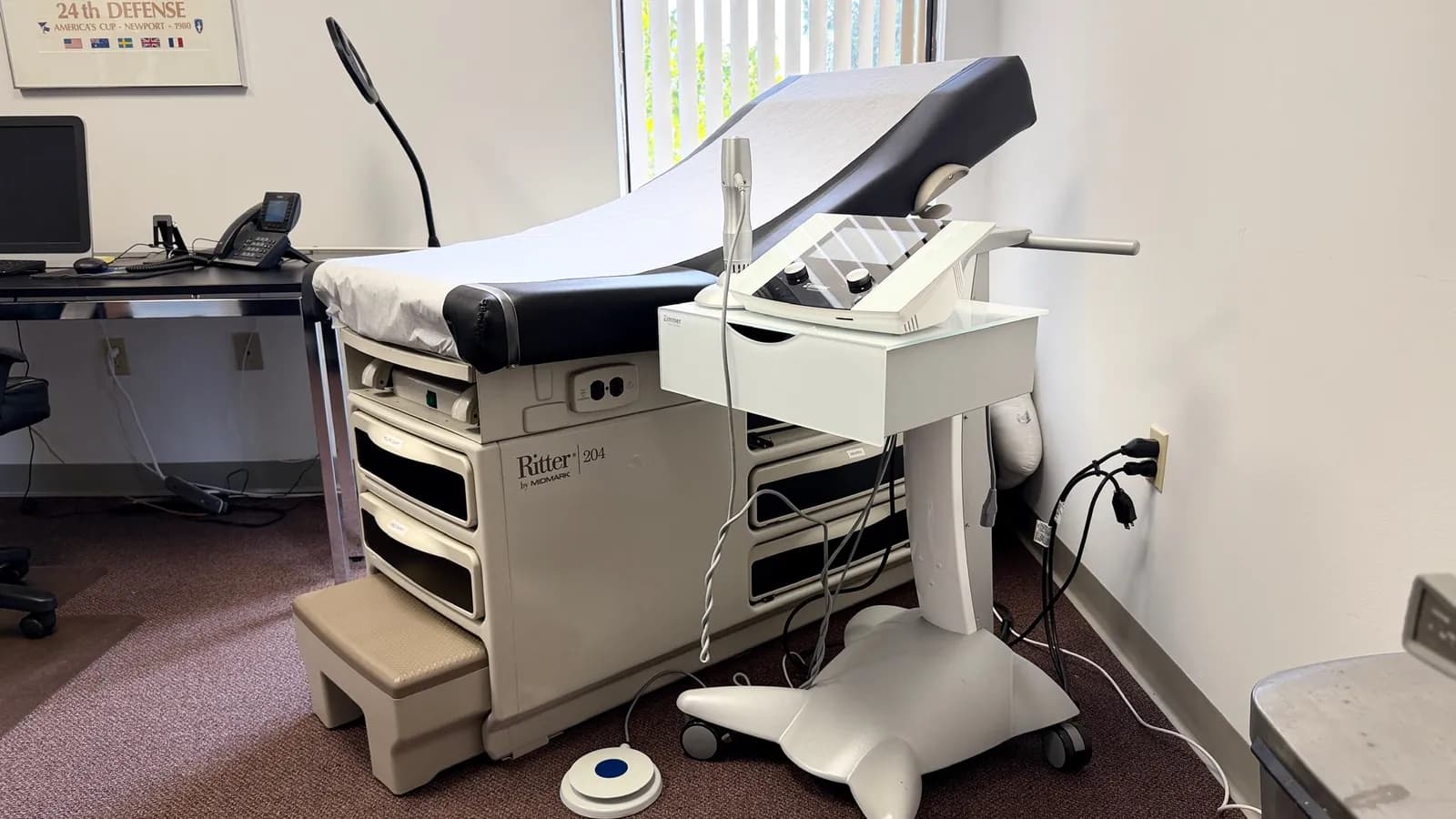
Shockwave therapy applies acoustic pressure waves to penile tissue from outside the body — no needles, no anesthesia. Orlando Sexual Medicine uses a radial pressure-wave system, the same category of technology used across U.S. medical and sports-medicine practices for soft-tissue treatment.
Its use for ED is off-label, physician-directed medicine — true of every acoustic-wave device on the market, whatever the brand — and candidacy here is decided by evaluation, not by advertising. The full regulatory record is at the bottom of this page, in plain words.
Straight talk about the evidence
The American Urological Association classifies shockwave therapy for ED as investigational, and most published trial results — including the numbers you may see quoted on other websites — come from focused shockwave devices, a different technology from the radial pressure-wave device we use. We don’t borrow those numbers, and we won’t promise you a result.
Here is what we do instead. Before anyone is offered treatment, the diagnostic work-up — duplex Doppler ultrasound of penile blood flow and nerve-sensitivity testing — establishes whether there is a vascular problem that pressure-wave therapy could plausibly address. European urology guidance reserves shockwave-type treatment for selected men with mild vascular ED or men who respond poorly to ED tablets; if your work-up doesn’t fit that picture, we’ll tell you, and we’ll recommend what fits instead. And because your baseline was measured, you’ll have objective findings — not just impressions — to judge progress against. See the full range of ED treatment we offer →
Our course of treatment
- 12 sessions, usually about twice a week, delivered consecutively where scheduling allows. This is our practice’s schedule — published protocols vary, and 12 sessions is not a universal standard.
- A low-dose daily medication is typically included during the course as part of the course. Because that medication is independently active, improvement during a course cannot be attributed to the device alone — we say that plainly.
- Patients are advised to avoid anti-inflammatories (such as ibuprofen) during the course; you’ll get the full instruction sheet at your first session.
- Candidacy is determined at consultation — certain conditions rule treatment out, and we screen for them before anything is scheduled.
Common questions
- Does shockwave therapy hurt?
- Sessions are brief and done in the office without anesthesia; what to expect physically is explained before your first session.
- Why won’t you quote a success rate?
- Because honest numbers for our specific device and patients don’t exist in the published research. We’d rather measure your baseline, treat, and judge by your own results than borrow a figure from someone else’s device.
- Is it covered by insurance?
- Not currently — insurers don’t cover shockwave therapy for ED, so it’s paid out of pocket. That isn’t the practice declining insurance: the office does participate with Medicare and bills most commercial plans for the evaluation itself. Costs for the course are explained clearly at consultation, before you commit to anything. What we bill and what we don’t →
Seen 'GAINSWave' advertised?
GAINSWave® is a marketing brand under which member clinics offer shockwave therapy — the treatment underneath is the same category of acoustic-wave therapy described on this page. Whatever the brand name on the ad, the questions worth asking are identical: what device is used, what course of treatment, what evidence supports it, and who evaluates you before anything is sold. Those are exactly the questions this page — and your consultation — answer.
Where it fits
Shockwave is one option among several — it is never the only door. The diagnostic evaluation comes first; treatment recommendations follow from it, and alternatives such as injection therapy are always on the table.
The regulatory record, in plain words
This device is not FDA-approved and not FDA-cleared to treat erectile dysfunction or Peyronie’s disease — and no shockwave or acoustic-wave device from any manufacturer has FDA approval or clearance for these conditions, whatever brand name appears in the ad. Use for these conditions is off-label, prescribed at the physician’s discretion after evaluation. Research is ongoing, and individual results vary.
Care provided by George Carroll, M.D.
Medically reviewed by George W. Carroll, MD (Florida license ME48111) · Reviewed August 2026
Ask the questions the ads don’t answer
Even if you choose to do nothing, it’s worth knowing what’s going on. Dr. Carroll will tell you, and the decision stays yours. One call to our office starts it — no obligation, no pressure, and no one pushing you toward a decision.
Office hours: Mon–Fri 9:00 AM – 5:00 PM. Callbacks are returned the same business day — the next business day for requests made after hours.